
Your Voice Heard: Protecting Medical Malpractice Victims, One Case at a Time. We Review Medical Records Free. Call Now.
4 Indiana Ave Valparaiso, IN 46383
in**@*******aw.com
(219) 464-3246

If a doctor, surgeon, hospital, or medical professional in Indiana made a mistake that injured you or someone you love, Langer & Langer can determine whether you have a medical malpractice case and what it’s worth.
We have recovered more than $9 million in a single medical malpractice case. We’ve handled birth injuries, surgical errors, emergency room failures, misdiagnoses, medication errors, and hospital negligence claims across every major city in Indiana. Lead attorney Steve Langer was named Trial Lawyer of the Year by the Indiana Trial Lawyers Association – twice – and serves as State Chair of the American College of Trial Lawyers.
Indiana’s medical malpractice laws are strict. You have two years to file. You must go through a Medical Review Panel. And there is a $1.8 million cap on total damages for malpractice occurring after June 30, 2019. We know this system because we’ve litigated in it for over 40 years.
From Valparaiso to Indianapolis and beyond, Langer & Langer fights for medical malpractice victims across Indiana – bringing decades of experience directly to your community.
When medical treatment leaves you with unanswered questions, a few early steps can help preserve the details you need to understand your situation.
Here is what you should do:
A poor medical result or unexpected complication never proves malpractice. Under Indiana law, a medical malpractice claim must satisfy four legal elements:
1. Doctor-patient relationship
A treatment relationship existed with a physician, surgeon, hospital, or licensed healthcare provider.
2. Accepted standard of care
The provider was required to follow established medical practices, such as proper diagnostic testing or surgical protocols.
3. Breach of duty
The provider failed to meet that standard, for example, by misreading imaging, operating on the wrong site, or prescribing an unsafe dosage.
4. Causation and damages
The breach caused measurable harm, including permanent injury, worsened condition, or wrongful death.
Each element must be supported by medical records, treatment timelines, and expert review. An Indiana medical malpractice attorney evaluates whether these legal requirements are met under state law.
Medical malpractice can take many forms, and each case depends on how the error occurred and where the breakdown in care happened. Our attorneys represent patients across Indiana in a wide range of serious medical negligence claims.
Common medical malpractice cases our qualified lawyers handle:

Errors during pregnancy, labor, or delivery that cause harm to an infant or mother, including birth trauma, cerebral palsy, Erb’s palsy, fetal distress, or hypoxic ischemic encephalopathy (HIE).

Failures in diagnosing or treating heart conditions, such as missed heart attacks, improper cardiac testing, delayed intervention, or medication errors affecting cardiac function.

Breakdowns in information sharing between providers, departments, or shifts that lead to delayed treatment, incorrect orders, or unsafe patient transfers.
Mistakes made in high-pressure emergency settings, including failure to diagnose stroke or heart attack, premature discharge, or delayed life-saving treatment.

System-level failures involving staffing, supervision, infection control, or patient safety protocols that result in preventable harm.

Errors involving incorrect prescriptions, wrong dosages, dangerous drug interactions, or failure to monitor patient reactions.

Misreading imaging studies, delayed reporting of critical findings, or failure to communicate abnormal results to treating physicians.

Failure to correctly identify a medical condition, including delayed or missed diagnosis of cancer, stroke, or other serious illnesses.

Preventable mistakes during surgery, such as wrong-site procedures, retained foreign objects, anesthesia errors, or improper surgical technique.
At Langer & Langer, our investigation begins with a close review of the medical events that led to your injury. Our medical negligence lawyers examine how care was delivered, where decision-making broke down, and whether the evidence supports a medical malpractice claim under state law.
We prioritized our steps based on investigation → records review → expert consultation → negotiation → trial.

Here’s our complete process:
Indiana medical malpractice cases follow specific laws that determine how claims are filed, reviewed, and compensated. These rules affect every stage of a case, from proving negligence to accessing compensation through the Patient’s Compensation Fund. Understanding these requirements helps clarify what to expect when pursuing a malpractice claim.
1. Indiana Medical Malpractice Act (Indiana Code § 34-18)
The Indiana Medical Malpractice Act governs claims against qualified healthcare providers, including physicians, hospitals, clinics, and medical facilities. It establishes:
This act also creates the framework for the Medical Review Panel and the Patient’s Compensation Fund.
2. Indiana Patient’s Compensation Fund (PCF)
The Patient’s Compensation Fund provides additional compensation when a patient’s proven damages exceed the amount a qualified healthcare provider is legally responsible for. Accessing the PCF requires full compliance with the Medical Malpractice Act’s filing and review procedures. Current caps under Indiana law include:
For malpractice occurring after June 30, 2019:
For malpractice occurring after June 30, 2017 and before July 1, 2019:
For malpractice occurring after June 30, 1999 and before July 1, 2017:
3. Medical Review Panel requirement (Indiana Code § 34-18-10)
A Medical Review Panel consists of one attorney who serves as a non-voting chair and three healthcare providers selected from the relevant medical specialty who serve as the voting members. The panel:
The panel’s opinion is not final, but it strongly influences how claims proceed.
4. Statute of Limitations for Medical Malpractice
Indiana imposes highly restrictive statutes of limitations in medical malpractice claims, giving patients a limited time to act. In general:
These exceptions are narrow and fact-specific, making early legal review essential.
Liability in a medical malpractice lawsuit depends on who controlled the treatment decisions and whether the evidence supports doctor negligence, hospital liability, or failures within larger healthcare systems. Accountability is based on evidence such as medical records, staffing roles, and decision authority, not job titles.
1. Physicians and surgeons: Individual providers, such as attending doctors or specialists, who made diagnostic or treatment decisions.
2. Hospitals and health systems: Institutions responsible for staffing levels, protocols, supervision, and patient safety systems.
3. Nurses and clinical staff: Licensed professionals involved in medication administration, monitoring, or patient handoffs.
4. Clinics and outpatient facilities: Surgical centers, urgent care clinics, or diagnostic facilities where errors occurred.
5. Corporate or management entities: Organizations that set policies, staffing models, or cost controls affecting patient care.
In many malpractice cases, liability is shared because errors often occur at multiple points in the treatment timeline. Our lawyer evaluates how each party’s actions or omissions breached the accepted standard of care under Indiana law.
Medical negligence can occur at any point in a patient’s care, from the first evaluation to follow-up treatment. These errors reflect breakdowns in clinical decision-making or communication that fall outside safe medical practice.
Common forms of healthcare negligence our legal team handles:
Failure to follow accepted diagnostic practices: Providers overlook symptoms, delay appropriate testing, or fail to act on abnormal results that a reasonably careful clinician would have addressed.
Breakdowns in clinical communication: Key information is not shared during handoffs, transfers, or shift changes, leading to missed updates and preventable errors.
Medication management failures: Errors occur in prescribing, dosing, monitoring, or identifying dangerous drug interactions.
Improper clinical decision-making: Treatment choices are made without adequate evaluation, risk assessment, or consideration of the patient’s medical history.
Inadequate monitoring or follow-up care: Changes in a patient’s condition go unnoticed because required monitoring protocols or follow-up responsibilities were not followed.
Lack of informed consent: Patients are not given material information about risks, alternatives, or likely outcomes before treatment decisions are made.
Compensation in a medical malpractice case begins with proving the full extent of the harm a patient suffered. We help victims document these losses through medical records, financial evidence, and expert evaluation so every qualifying form of compensation is accounted for.
Compensation generally falls into two categories:
A complete damages evaluation looks at the financial costs you’ve incurred, the care you will need in the future, and the ways the injury has changed your life at home and at work.
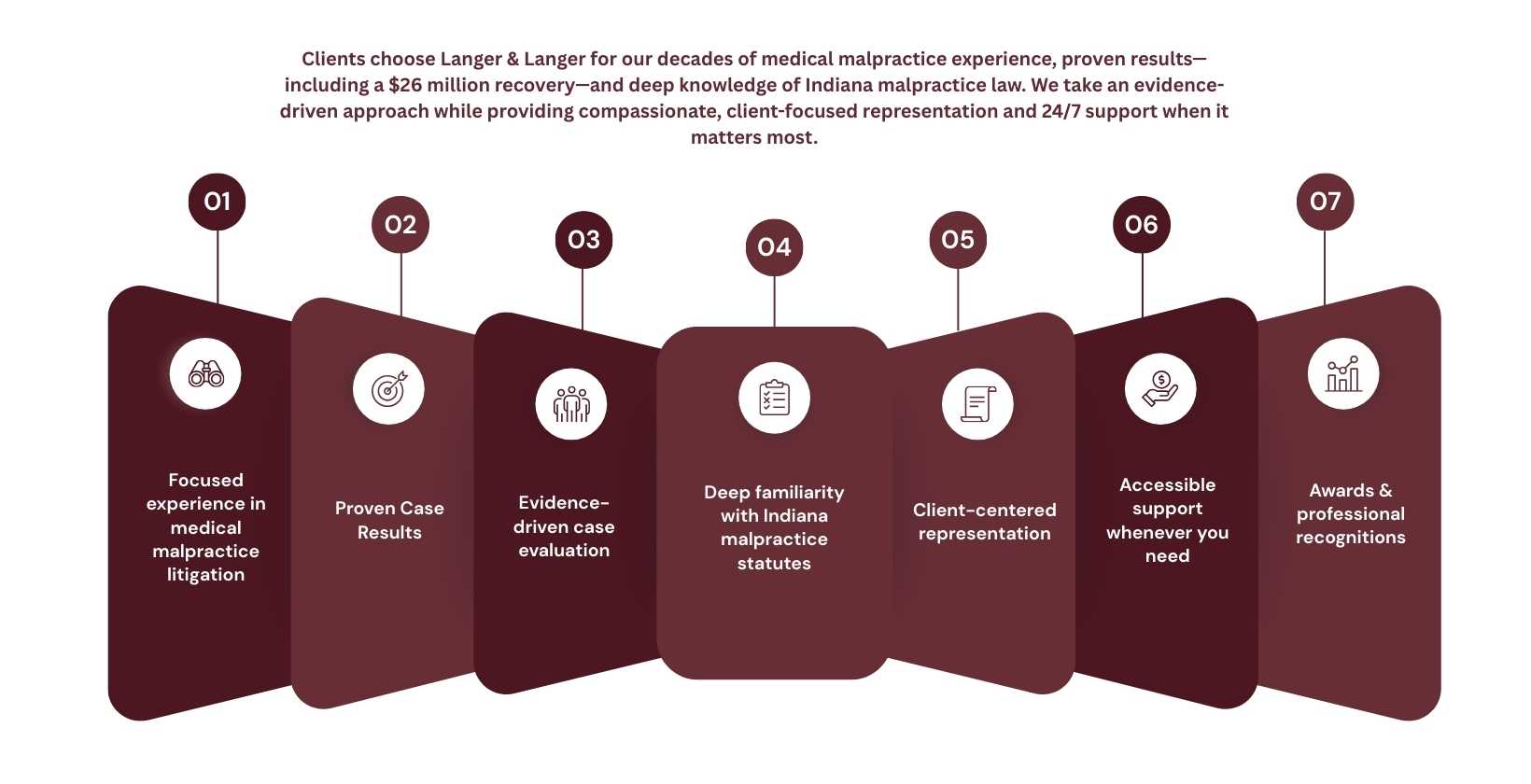
Medical malpractice claims require experience, precision, and persistence. Clients choose our medical malpractice law firm because we bring those strengths to every case we take on.


Our injury lawyers have the answers to the most frequently asked questions about medical malpractice.
At Langer & Langer, our medical malpractice lawyer works on a contingency fee basis. You pay no upfront fees, and our medical malpractice lawyers are paid only when your medical malpractice claim recovers compensation.
Yes. You can file a malpractice claim if you signed a consent form, because a consent form does not excuse malpractice or a breach of the medical standard of care during treatment.
Medical malpractice cases take longer because they require medical record review, expert analysis, and statutory procedures. These cases involve complex causation issues, professional standards, and mandatory review steps that are not required in ordinary injury claims.
Yes. Families can file a wrongful death claim when medical malpractice causes a patient’s death. The estate or eligible family members may seek compensation for medical costs, funeral expenses, and the financial impact of the loss.
Yes, most medical malpractice claims must go through a Medical Review Panel in Indiana. The panel evaluates whether the evidence supports a breach of the accepted standard of care before the case proceeds in court.
Yes. A hospital or insurance company can deny a malpractice claim even when negligence occurred. Denial does not determine validity, which is resolved through medical evidence, expert review, and the legal process.
Medical errors are complex. We cut through the confusion – just share your records and our team will give you an honest case evaluation, free of charge.

© 1980-2026 Langer & Langer • All Rights Reserved
Copyright © 1980-2026 All Rights Reserved.
Past results do not guarantee any future outcome, and every case is different.
We improve our products and advertising by using Microsoft Clarity to see how you use our website. By using our site, you agree that we and Microsoft can collect and use this data.
Have legal questions or need expert advice? Our experienced team is here to help.
Langer and Langer
Accessibility Statement
Compliance status
We firmly believe that the internet should be available and accessible to anyone, and are committed to providing a website that is accessible to the widest possible audience, regardless of circumstance and ability.
To fulfill this, we aim to adhere as strictly as possible to the World Wide Web Consortium’s (W3C) Web Content Accessibility Guidelines 2.1 (WCAG 2.1) at the AA level. These guidelines explain how to make web content accessible to people with a wide array of disabilities. Complying with those guidelines helps us ensure that the website is accessible to all people: blind people, people with motor impairments, visual impairment, cognitive disabilities, and more.
This website utilizes various technologies that are meant to make it as accessible as possible at all times. We utilize an accessibility interface that allows persons with specific disabilities to adjust the website’s UI (user interface) and design it to their personal needs.
Additionally, the website utilizes an AI-based application that runs in the background and optimizes its accessibility level constantly. This application remediates the website’s HTML, adapts Its functionality and behavior for screen-readers used by the blind users, and for keyboard functions used by individuals with motor impairments.
If you’ve found a malfunction or have ideas for improvement, we’ll be happy to hear from you. You can reach out to the website’s operators by using the following email
Screen-reader and keyboard navigation
Our website implements the ARIA attributes (Accessible Rich Internet Applications) technique, alongside various different behavioral changes, to ensure blind users visiting with screen-readers are able to read, comprehend, and enjoy the website’s functions. As soon as a user with a screen-reader enters your site, they immediately receive a prompt to enter the Screen-Reader Profile so they can browse and operate your site effectively. Here’s how our website covers some of the most important screen-reader requirements, alongside console screenshots of code examples:
Screen-reader optimization: we run a background process that learns the website’s components from top to bottom, to ensure ongoing compliance even when updating the website. In this process, we provide screen-readers with meaningful data using the ARIA set of attributes. For example, we provide accurate form labels; descriptions for actionable icons (social media icons, search icons, cart icons, etc.); validation guidance for form inputs; element roles such as buttons, menus, modal dialogues (popups), and others. Additionally, the background process scans all the website’s images and provides an accurate and meaningful image-object-recognition-based description as an ALT (alternate text) tag for images that are not described. It will also extract texts that are embedded within the image, using an OCR (optical character recognition) technology. To turn on screen-reader adjustments at any time, users need only to press the Alt+1 keyboard combination. Screen-reader users also get automatic announcements to turn the Screen-reader mode on as soon as they enter the website.
These adjustments are compatible with all popular screen readers, including JAWS and NVDA.
Keyboard navigation optimization: The background process also adjusts the website’s HTML, and adds various behaviors using JavaScript code to make the website operable by the keyboard. This includes the ability to navigate the website using the Tab and Shift+Tab keys, operate dropdowns with the arrow keys, close them with Esc, trigger buttons and links using the Enter key, navigate between radio and checkbox elements using the arrow keys, and fill them in with the Spacebar or Enter key.Additionally, keyboard users will find quick-navigation and content-skip menus, available at any time by clicking Alt+1, or as the first elements of the site while navigating with the keyboard. The background process also handles triggered popups by moving the keyboard focus towards them as soon as they appear, and not allow the focus drift outside it.
Users can also use shortcuts such as “M” (menus), “H” (headings), “F” (forms), “B” (buttons), and “G” (graphics) to jump to specific elements.
Disability profiles supported in our website
Additional UI, design, and readability adjustments
Browser and assistive technology compatibility
We aim to support the widest array of browsers and assistive technologies as possible, so our users can choose the best fitting tools for them, with as few limitations as possible. Therefore, we have worked very hard to be able to support all major systems that comprise over 95% of the user market share including Google Chrome, Mozilla Firefox, Apple Safari, Opera and Microsoft Edge, JAWS and NVDA (screen readers).
Notes, comments, and feedback
Despite our very best efforts to allow anybody to adjust the website to their needs. There may still be pages or sections that are not fully accessible, are in the process of becoming accessible, or are lacking an adequate technological solution to make them accessible. Still, we are continually improving our accessibility, adding, updating and improving its options and features, and developing and adopting new technologies. All this is meant to reach the optimal level of accessibility, following technological advancements. For any assistance, please reach out to