
4 Indiana Ave Valparaiso, IN 46383
in**@*******aw.com
(219) 464-3246

Prescription and medication-related errors are often preventable, yet mistakes can occur at any stage of care, including when a drug is prescribed, dispensed by a pharmacy, or administered in a hospital.
If you experienced unexpected side effects, a worsening condition, or needed additional treatment or hospitalization after taking a medication, the harm may be linked to an avoidable error, such as the wrong drug, an unsafe dosage, or a combination of medications that should not be taken together.
At Langer & Langer, our Indiana medication error lawyers represent patients and families harmed by prescription and medication mistakes. We investigate what went wrong, determine who may be responsible, and explain whether Indiana law allows you to seek compensation for medical expenses, lost income, and other losses connected to preventable harm.
If you suspect a prescription error affected your health, contact us for a free, no-obligation consultation. You can speak with our team by phone or visit our office at 4 Indiana Ave, Valparaiso, IN 46383 to discuss your situation in person.
Not every medication-related problem is malpractice. Under Indiana law, a medication mistake may support a medical malpractice claim when the error was preventable, fell below the accepted standard of care, and caused actual harm.
Medication negligence commonly occurs during one of the following stages of care:
Prescribing
A doctor orders the wrong medication, an unsafe dosage, or a combination of drugs that should not be taken together, sometimes leading to unexpected side effects or a rapid decline in a patient’s condition.
Dispensing
A pharmacy fills a prescription incorrectly or provides the wrong strength, which may cause symptoms to worsen shortly after the medication is taken.
Administration
A hospital or nursing provider gives the wrong medication or dose, potentially resulting in emergency treatment or hospitalization.
Monitoring
A healthcare provider fails to watch for side effects or drug interactions, allowing avoidable complications to progress before they are addressed.
If this reflects your experience, you may contact our office to discuss your situation.
Liability in a prescription mistake case depends on who failed to meet their professional duty and how that failure contributed to the injury. In Indiana, responsibility may rest with one provider or be shared among multiple parties involved in a patient’s care.
Depending on how the prescription mistake occurred, liable parties may include:
Physicians who prescribe the wrong medication, an unsafe dosage, or a combination of drugs that should not be taken together.
Nurses or hospital staff who administer medication without proper verification, give the wrong dose, or provide medication to the wrong patient.
Pharmacists or pharmacy chains that fill prescriptions incorrectly, dispense the wrong strength, or label medications improperly.
Hospitals, clinics, or healthcare facilities that fail to enforce medication safety procedures, maintain adequate oversight, or properly train staff.
Our experienced prescription error attorneys review each stage of treatment and the relevant records to identify where the breakdown occurred and which parties may be accountable.
In medication malpractice cases, it is important to distinguish between a medication error and an adverse drug event, because the legal implications are different. The distinction turns on whether the harm resulted from a preventable mistake or from a medication that was properly prescribed and administered.
Key Differences Explained:
| Scope | Medication Error | Adverse Drug Event |
|---|---|---|
| Nature of the problem | Preventable mistake in care. | Reaction without a preventable mistake. |
| How it occurs | Wrong drug, wrong dose, unsafe combination, or improper administration. | Known or possible side effect of a correctly given medication. |
| Stage of care involved | Prescribing, dispensing, administration, or monitoring. | Medication handled according to medical standards. |
| Role of negligence | Involves a failure to meet the standard of care. | No negligence required. |
| Legal relevance | May support a medical malpractice claim. | Does not, by itself, support malpractice. |
| Proof required | Error, negligence, and resulting harm. | Harm alone is insufficient. |
Medication error cases in Indiana follow a structured legal process. Navigating that process requires careful documentation, timing, and coordination under Indiana’s medical malpractice framework.
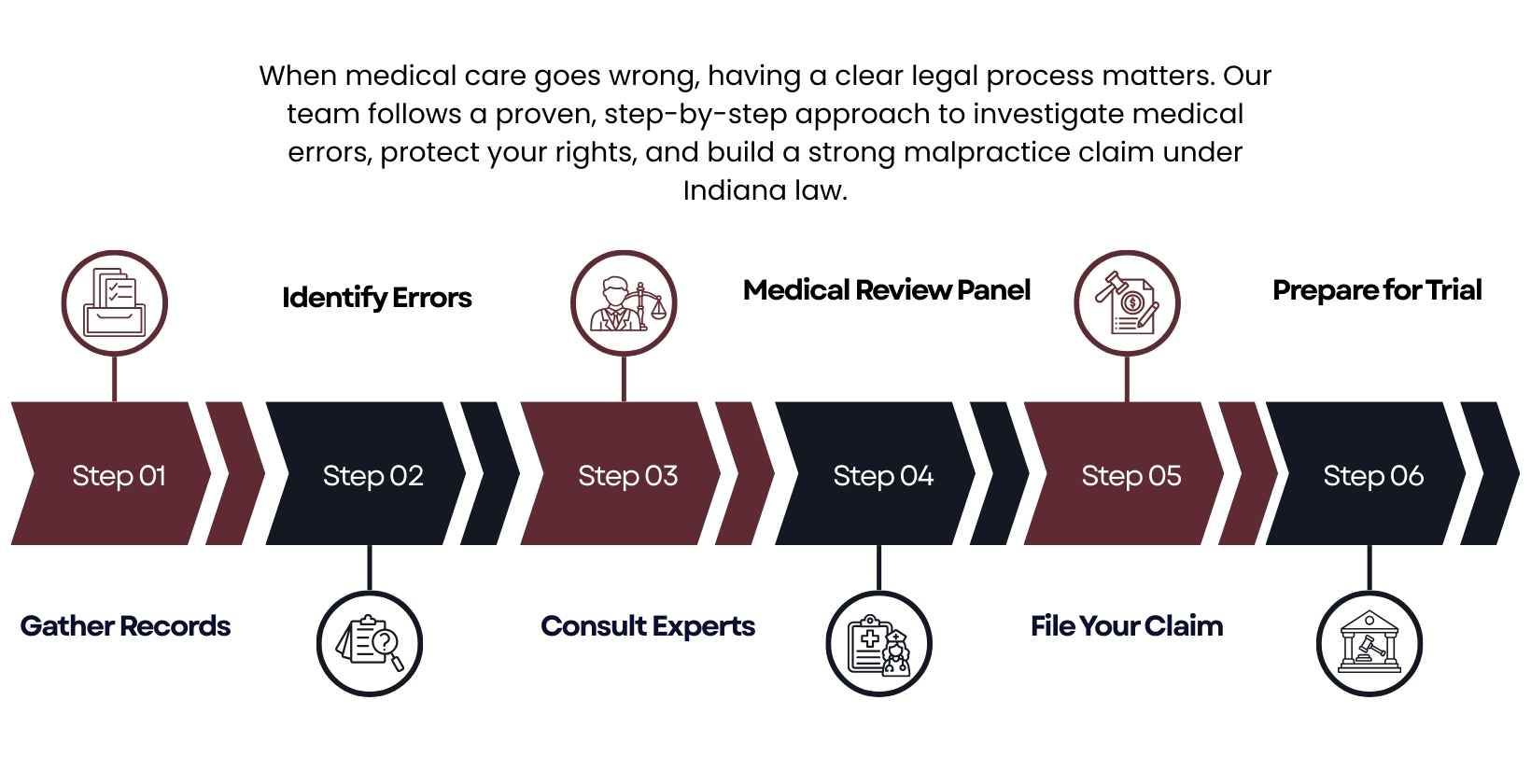
A medication error alone does not establish medical malpractice. To pursue a claim under Indiana law, it must be shown that a healthcare provider failed to meet the accepted standard of care and that this failure caused actual harm.
Our pharmacy error attorneys focus on specific medical and legal elements to determine whether negligence caused harm. This analysis includes:
Medication error cases often involve complex medical records and overlapping care providers. Careful analysis is required to show not only that a mistake occurred, but that it directly resulted in harm.
Medication mistakes can cause a wide range of harm, from temporary complications to permanent injury or death, depending on the medication involved, the dosage, and how quickly the error is identified and treated. When a medication-related error qualifies as medical malpractice, Indiana law allows injured patients and families to seek compensation for losses directly tied to the injury.
Depending on the facts of the case, available damages may include:
Hospital care, follow-up treatment, prescription medications, rehabilitation, and ongoing medical needs related to the injury.
Wages missed during recovery or long-term limitations that affect the ability to work.
Physical discomfort, emotional distress, and the impact the injury has on daily life.
Losses related to lasting conditions that affect independence or quality of life.
Financial losses suffered by surviving family members when a fatal medication mistake occurs.
Indiana law places statutory limits on damages in medical malpractice cases. For acts of malpractice that occurred on or after July 1, 2019, the total amount recoverable is capped at $1.8 million, regardless of the severity of the injury. A qualified healthcare provider is generally responsible for up to $500,000, with additional compensation, when applicable, paid through the Indiana Patient’s Compensation Fund.
When a medication mistake is suspected, the first priority is health and safety. Taking a few practical steps early can also help preserve information that may later clarify what happened.
Free case review available. Our attorneys review medical and pharmacy records to determine whether a medication mistake meets the legal requirements for a claim under Indiana law.
Medication error cases often involve detailed medical records, pharmacy data, and Indiana-specific malpractice procedures. We have handled these issues for decades in cases across the state.
100+ years of combined malpractice litigation experience:
Longstanding experience representing patients in medical malpractice cases throughout Indiana.
Deep understanding of Indiana malpractice law:
Familiarity with statutory requirements, damage caps, filing deadlines, Medical Review Panels, and the Indiana Patient’s Compensation Fund.
Personal attention and responsive communication:
Clear updates and timely responses throughout the legal process.
Clear fee structure:
Representation is offered on a contingency fee basis. Fee terms and any cost responsibilities are explained in the written fee agreement.
Our attorneys approach these cases with the attention and diligence they demand.
Every case we handle is personal, and our results reflect the care, focus, and experience we bring to each one. We’ve helped families across Indiana recover compensation, including:
Client Testimonials:
Robert was extremely helpful and informative and made room to meet with me even though his schedual was tight! Even though he wasn't able to help me moving forward he gave me the advice and confidence I needed to move forward on my own! I highly recommend him.
Robert representative after a bad car accident for myself and my family. He was everything that we had hoped for in an attorney to deal with this challenging situation. I highly recommend Langer and Langer especially Robert for any personal injury needs.
I highly recommend Steve Langer & his attorneys for medical malpractice representation. From the beginning I have always felt that they listened intently with care & compassion. There were always available to answer any of my questions and concerns. I can’t thank Steve Langer enough for getting justice for my Mom.
We value every outcome, but more importantly, we value the trust our clients place in us. If you’re facing a medication error, we’re here to help.
Langer & Langer represents clients across Indiana in medication error and medical malpractice matters arising from hospitals, clinics, and pharmacies.
Our medication malpractice attorneys handle medication error cases in:
We also represent clients statewide, regardless of where the medication error occurred.
In Indiana, a medication error claim must generally be filed within 2 years from the date of the alleged act or omission. For children under age six, the deadline may extend until the child’s eighth birthday.
Indiana law requires most medication error claims against qualified healthcare providers to be reviewed by a Medical Review Panel before the case may proceed in court. The panel evaluates medical records and expert opinions but does not decide liability or award damages. This review is a procedural step required under the Indiana Medical Malpractice Act.
Medical records, prescription histories, pharmacy receipts, discharge instructions, and a written timeline of events can help provide context when a medication error is reviewed. Having this information available allows for a more efficient evaluation of what occurred and what steps may apply.
No. A consent form generally acknowledges known risks of treatment, but it does not excuse negligence. If a preventable medication mistake occurred, signing a consent form does not automatically bar a malpractice claim under Indiana law.
Questions following a prescribing or dispensing error often require prompt legal review. Our experienced medical malpractice attorneys can review your records, explain your options under Indiana law, and guide you through the process.
Schedule a free, no-obligation consultation by calling 219-464-3246 or submitting a request through our secure contact form. You pay nothing unless we recover compensation on your behalf.



© 1980-2026 Langer & Langer • All Rights Reserved
Copyright © 1980-2026 All Rights Reserved.
Past results do not guarantee any future outcome, and every case is different.
We improve our products and advertising by using Microsoft Clarity to see how you use our website. By using our site, you agree that we and Microsoft can collect and use this data.
Have legal questions or need expert advice? Our experienced team is here to help.
Langer & Langer
Accessibility Statement
Compliance status
We firmly believe that the internet should be available and accessible to anyone, and are committed to providing a website that is accessible to the widest possible audience, regardless of circumstance and ability.
To fulfill this, we aim to adhere as strictly as possible to the World Wide Web Consortium’s (W3C) Web Content Accessibility Guidelines 2.1 (WCAG 2.1) at the AA level. These guidelines explain how to make web content accessible to people with a wide array of disabilities. Complying with those guidelines helps us ensure that the website is accessible to all people: blind people, people with motor impairments, visual impairment, cognitive disabilities, and more.
This website utilizes various technologies that are meant to make it as accessible as possible at all times. We utilize an accessibility interface that allows persons with specific disabilities to adjust the website’s UI (user interface) and design it to their personal needs.
Additionally, the website utilizes an AI-based application that runs in the background and optimizes its accessibility level constantly. This application remediates the website’s HTML, adapts Its functionality and behavior for screen-readers used by the blind users, and for keyboard functions used by individuals with motor impairments.
If you’ve found a malfunction or have ideas for improvement, we’ll be happy to hear from you. You can reach out to the website’s operators by using the following email
Screen-reader and keyboard navigation
Our website implements the ARIA attributes (Accessible Rich Internet Applications) technique, alongside various different behavioral changes, to ensure blind users visiting with screen-readers are able to read, comprehend, and enjoy the website’s functions. As soon as a user with a screen-reader enters your site, they immediately receive a prompt to enter the Screen-Reader Profile so they can browse and operate your site effectively. Here’s how our website covers some of the most important screen-reader requirements, alongside console screenshots of code examples:
Screen-reader optimization: we run a background process that learns the website’s components from top to bottom, to ensure ongoing compliance even when updating the website. In this process, we provide screen-readers with meaningful data using the ARIA set of attributes. For example, we provide accurate form labels; descriptions for actionable icons (social media icons, search icons, cart icons, etc.); validation guidance for form inputs; element roles such as buttons, menus, modal dialogues (popups), and others. Additionally, the background process scans all the website’s images and provides an accurate and meaningful image-object-recognition-based description as an ALT (alternate text) tag for images that are not described. It will also extract texts that are embedded within the image, using an OCR (optical character recognition) technology. To turn on screen-reader adjustments at any time, users need only to press the Alt+1 keyboard combination. Screen-reader users also get automatic announcements to turn the Screen-reader mode on as soon as they enter the website.
These adjustments are compatible with all popular screen readers, including JAWS and NVDA.
Keyboard navigation optimization: The background process also adjusts the website’s HTML, and adds various behaviors using JavaScript code to make the website operable by the keyboard. This includes the ability to navigate the website using the Tab and Shift+Tab keys, operate dropdowns with the arrow keys, close them with Esc, trigger buttons and links using the Enter key, navigate between radio and checkbox elements using the arrow keys, and fill them in with the Spacebar or Enter key.Additionally, keyboard users will find quick-navigation and content-skip menus, available at any time by clicking Alt+1, or as the first elements of the site while navigating with the keyboard. The background process also handles triggered popups by moving the keyboard focus towards them as soon as they appear, and not allow the focus drift outside it.
Users can also use shortcuts such as “M” (menus), “H” (headings), “F” (forms), “B” (buttons), and “G” (graphics) to jump to specific elements.
Disability profiles supported in our website
Additional UI, design, and readability adjustments
Browser and assistive technology compatibility
We aim to support the widest array of browsers and assistive technologies as possible, so our users can choose the best fitting tools for them, with as few limitations as possible. Therefore, we have worked very hard to be able to support all major systems that comprise over 95% of the user market share including Google Chrome, Mozilla Firefox, Apple Safari, Opera and Microsoft Edge, JAWS and NVDA (screen readers).
Notes, comments, and feedback
Despite our very best efforts to allow anybody to adjust the website to their needs. There may still be pages or sections that are not fully accessible, are in the process of becoming accessible, or are lacking an adequate technological solution to make them accessible. Still, we are continually improving our accessibility, adding, updating and improving its options and features, and developing and adopting new technologies. All this is meant to reach the optimal level of accessibility, following technological advancements. For any assistance, please reach out to